One of my favorite songs to explore with students in the fall is Simple Gifts. I love using repertoire that is rich and deep in its history, content, and application. In this post, I’ll be sharing all of the ways you could use Simple Gifts in your upper elementary classes.
If you’re unfamiliar with the tune Simple Gifts, it is a Shaker tune that was written by Elder Joseph Brackett, who was part of the Maine Shaker community. The song was written in 1848 and was written as a dance tune. The Shakers were a religious group that were named for their “ecstatic dancing.” The Shaker religion is fascinating in its evolution and beliefs. You can learn more about the Shakers here.
Melody
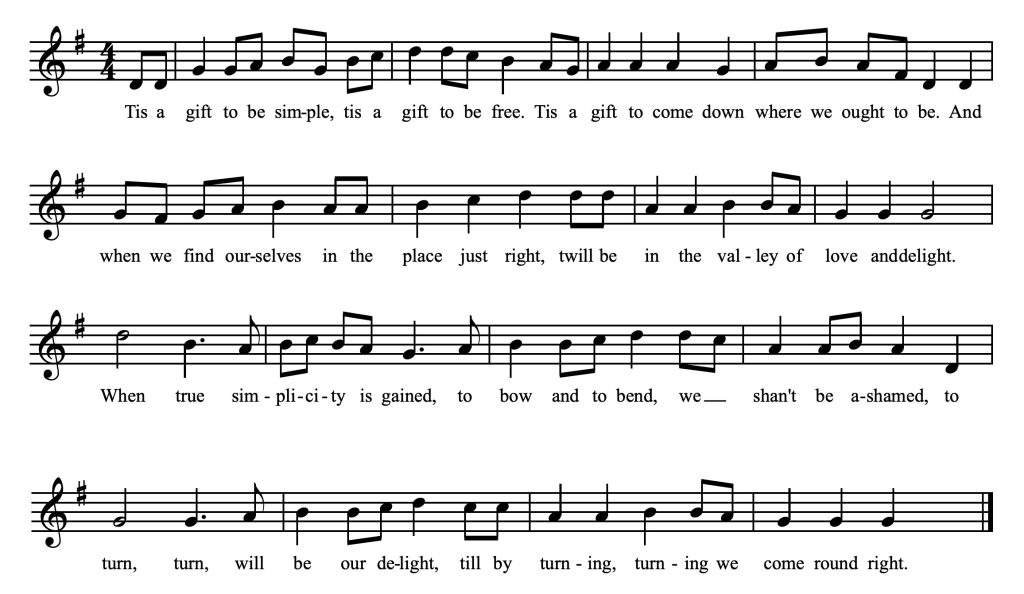
There are many things we can teach about the melody of Simple Gifts. What content you cover will depend upon the grade level you are teaching. Here are some ideas to draw upon from the song:
- Tonality – is the song in major or minor tonality?
- Does the song begin and end of the resting tone?
- How does the melody move? By step, skip, or leap?
- Where are the phrases? Does a phrase ever repeat?
- If you’re working with older students, you might even discuss how passing tones are used within the melody.
Why is it important to discuss these melodic elements? In identifying these elements in music, it helps our students to understand how melodies are constructed. It’s takes the mystery out of creating and helps our students to see that creating and composing are accessible to them as a form of self expression.
Rhythm
There are so many rhythmic elements for your students to explore in Simple Gifts as well. Here are some ideas for you to consider exploring with your students.
- Meter – is the song in duple or triple meter?
- Meter signature – if using the sheet music, you can introduce & discuss the meter (time signature)
- Durations such as quarter note, eighth note, half note, dotted quarter/eighth note, and quarter rest.
- Pick-up note at the start of the song
- Identify patterns within the song? What rhythms are present? What patterns repeat throughout the song?
- If you’re working with older students, you might discuss how passing tones change the rhythms used in the song?
Movement
Knowing that Simple Gifts was written as a dance tune, I searched for the folk dance that accompanied it. I cannot verify the authenticity of the dances, but here are some versions I found. It might be interesting to share these versions with students. Can your students identify the dance steps and formations present? These versions might be above where we are in our folk dance journey, but it might be a starting point for students to then create their own folk dance to the song.
Listening Lessons
One of my favorite follow-ups once my students have learned Simple Gifts is to share how others have taken the melody and made it their own. The most famous example is by American composer, Aaron Copland. His piece, Appalachian Spring brought the melody Simple Gifts out of obscurity. I love sharing Appalachian Spring with students and discussing how Aaron Copland created a unique American sound in classical music.
Another example of Simple Gifts I love to share is by Alison Krauss, featuring Yo-Yo Ma. It falls along the lines of Copland’s approach to creating a uniquely Americana sound. We can compare the different versions to find what is similar and what makes each version unique.
Lastly, I love sharing the version presented by Blast. If you’re unfamiliar with Blast, it’s a staged version of marching band show that was done at a time that STOMP was all the rage. There are so many fabulous tunes to share from Blast, but the Simple Gifts set is one of my favorites!
There are so many wonderful things to teach using Simple Gifts! I hope you come away with a few new ideas to use in your elementary classroom!
Related Blog Posts








Connect with me!